
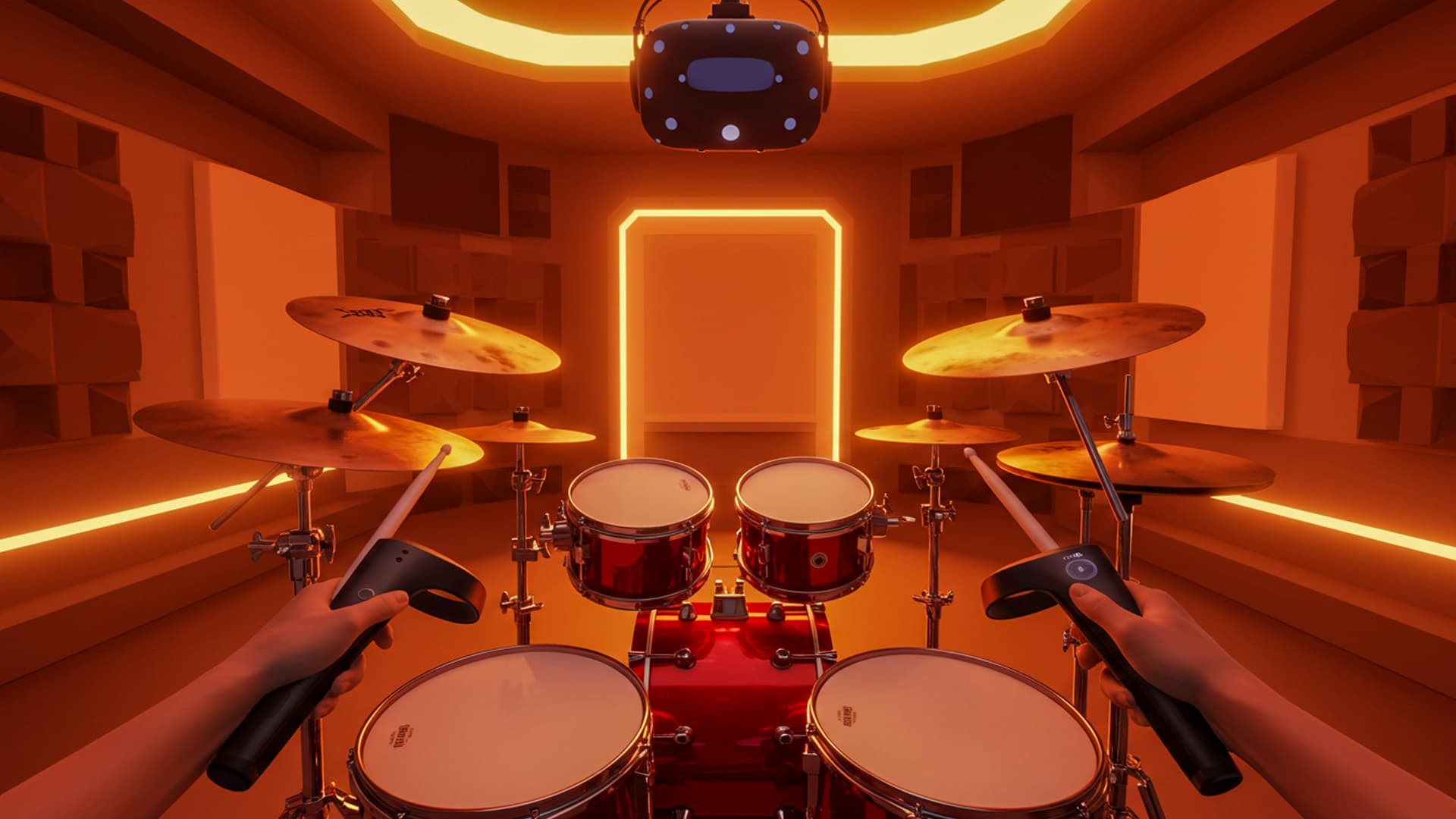
Making Music in VR with Patchworld
A Glimpse into Spatial Music Creation on Meta Quest 3 Put on a Meta Quest 3, boot up Patchworld, and the studio dissolves into a cathedral of...
A Glimpse into Spatial Music Creation on Meta Quest 3
Put on a Meta Quest 3, boot up Patchworld, and the studio dissolves into a cathedral of sound you can walk through. Knobs become constellations, patches turn into corridors, and your hands transform into conductive batons steering oscillators, sequencers, and effects in three-dimensional space. This essay follows an immersive journey into VR music production with Patchworld: the exhilaration of embodied composition, the nitty-gritty of workflow architecture, the craft of sound design in a volumetric canvas, and the pragmatic frictions you will encounter—bulk, battery, latency, and cognitive drift. Think of it as a field guide for producers who want to replace a desktop timeline with a room that breathes, pulses, and answers back.
Embodied Composition in Patchworld on Quest 3
Gestural Synthesis and Spatial Affordances
The first revelation is kinesthetic: gestures are promoted from “MIDI equivalents” to primary control primitives. In Patchworld, envelopes and LFOs do not merely modulate parameters; they inhabit space as manipulable entities. A filter sweep becomes a wrist arc; a crossfade is a literal stride from one sonic locus to another. This reassigns the composer’s proprioception as a modulation source, integrating posture and reach into the synthesis graph. You feel phrasing not just as time but as geometry—distance to a node equates to depth of effect, angle of approach maps to timbral contour. It’s like trading a piano roll for a choreographic score where movement and sound coauthor each other.
In practice, I built a groove by orbiting a floating sequencer, nudging velocity stems with fingertip taps while a spectral shaper hovered overhead, responding to vertical hand height. The cue to open the pad’s cutoff was a diagonal gesture I could perform without looking, a body-learned macro. This spatial affordance accelerates ideation because your hands never leave the instrument: no mouse, no window switching, no menu spelunking. The tradeoff is endurance—holding your arms up for extended sessions is aerobics for the deltoids—and precision, which depends on steadiness and controller tracking. Yet the immediacy of route-by-reach turns sound design into a dance that the DAW timeline rarely invites.
Modular Patching Without Cables
Patchworld’s modular metaphor sidesteps cable spaghetti with visual links and proximity logic. Instead of dragging cords, you snap modules into influence by moving them closer, rotating them until their interfaces “click,” or pointing and confirming with a gesture. The topology reads like a subway map rendered in midair: oscillators as stations, effects as interchanges, sequencers as express lines, mixers as depots. This makes routing legible at a glance and scalable because the space itself becomes the sheet of paper. I found it easiest to dedicate corners of the virtual room to functions—rhythm in the south, harmony to the east, texture overhead—so I could “walk the mix” as a spatial mnemonic.
There is discipline behind the spectacle. Good modular practice still applies: gain staging before flair, clock integrity before flourish, and systematic labeling so future-you remembers why a subpatch exists. I created color-coded plates floating near clusters—blue for time-based, amber for dynamics, violet for spectral—plus a few “bookmark anchors” that teleported me to critical nodes. Without tactile cables, you avoid accidental knots; without resistance, you can also overconnect. The antidote is intentional sparsity: delete nodes that duplicate a role and favor single-responsibility chains. In VR, clarity is a posture; the fewer objects between you and the phrase, the more musically ergonomic the experience becomes.
Latency, Head-Related Geometry, and Groove
Latency in VR is a double agent: audio buffer size and rendering pipeline delays mingle with human chronoception. On Quest 3, Patchworld feels playable, but stack too many reactive effects and microtiming drifts. The cure is a groove architecture that anticipates delay—quantize gestural triggers to subdivisions, prefer pre-roll launches, and use look-ahead envelopes on transient processors. Spatialization adds another layer: head-motion subtly alters HRTF cues, which changes perceived attack placement. I learned to anchor percussive sources near the visual center to minimize psychoacoustic misalignment, offloading wild spatialization to pads and FX where timing tolerance is higher.
Consider the drummer’s analogy: if your cymbals keep migrating as you turn your head, the ride pattern will feel slippery. Lock the metronomic core—kick, snare, hats—to a stable frontal locus or a follow-cam rig, then let auxiliary percussion orbit. For live gestural control, map critical toggles to binary, forgiving thresholds instead of hairline sliders. Reserve the most latency-sensitive actions (stutter, gated repeats) for quantized switches rather than freehand. This way, the groove survives minor pipeline stalls without audible flams. VR composition becomes less about chasing zero-latency and more about designing a resilient timing ecology.

Workflow Architecture: From Jam to Export
Session Planning and Cognitive Offloading
Traditional studios externalize memory with labels, recall sheets, and templates. In VR, environment design does the same job. Before each Patchworld session, I scaffold a “scene layout” that mirrors a song arc: left wall for idea capture, center for arrangement, right wall for mixdown, rear for utilities. Each zone hosts a small set of tools and a ritual—tap to arm, step to audition, look to commit. By encoding workflow as choreography, I reduce mental context switching. You don’t ask, “Where’s the resampler?” because your legs already know. This spatial checklist also prevents VR drift: the moment wandering begins, I step to the next zone and regain thread continuity.
For cognitive offloading, I rely on virtual sticky cards—floating note tiles with short prompts like “freeze percussion bus before granularizing” or “save a dry stem now.” These cues are not mere reminders; they’re micro-protocols that preempt failure states. One card reads “five-minute battery audit,” forcing me to check headroom on the headset and controllers. Another card is a “latency sanity ping,” a metronome tap that validates response before recording. The result is a session that behaves like a well-typed API: predictable, self-documenting, and resistant to entropy. When inspiration hits, you spend it on music instead of on reorienting your vestibular system.
Signal Flow Topologies in Virtual Space
Patchworld encourages thinking in constellations rather than lanes. I use three canonical topologies. First is the “radial bus”: sources on a ring feeding inward to a mastering hub—great for walking around the mix and tuning balances with literal proximity. Second is the “tiered cascade”: vertically stacked stages—source, dynamics, color, space—letting gravity act as a metaphor for energy flow. Third is the “modulation orchard”: parameter trees where common LFOs and envelopes branch to many destinations, visualizing rhythmic relationships. By naming these topologies, you gain a vocabulary for patch reuse. Switch projects, keep the shape, and your brain ports immediately to known ground.
A common hazard is uncontrolled feedback in a room-sized graph. VR makes loops tempting—why not feed the reverb back into a granulator across the space?—but it also makes them hard to read when your body occludes nodes. My safeguard is a “feedback perimeter”: any loop-capable node lives on an outer ring and uses color-coded intensity beams indicating return gain. If a beam deepens beyond a threshold, I know the loop is volatile. The same perimeter hosts limiters with generous headroom and a panic mute plate I can slap. The architecture, like a well-designed city, builds in firebreaks between districts.
Recording, Bouncing, and DAW Handshake
VR excels at ideation; traditional DAWs still win at editing, comping, and delivery. The handshake is stems. I capture multitrack buses inside Patchworld, bounce loopable sections, and export stems at consistent lengths with click-leading slates. The slate is crucial: when imported into a DAW, the click confirms alignment and roundtrip latency. For parts requiring meticulous micro-edits—vocal-chop rhythms, spectral surgery—I defer to the DAW, then re-import as a locked layer back into the VR room. Treated stems float above their origin nodes like constellations pinned to the sky, reminding me of provenance while keeping the environment navigable.
When the target is performance rather than post-production, I practice in VR with a “commit early” philosophy. Flatten modulation-heavy chains into resampled layers to reduce live CPU peaks, constrain gestural mappings to a small, well-rehearsed set, and keep emergency overrides obvious and physical: a giant freeze plate, a mute bay, a transport orb. If needed, I bridge to external gear via MIDI or OSC clock, letting a hardware sequencer dictate tempo stability while Patchworld provides the tactile theater. The DAW then becomes a scoreboard and recorder, not the center of gravity. In this division of labor, each system excels at what it was born to do.

Sound Design Tactics inside Patchworld
Granular and Physical Modeling Playgrounds
Granular engines in Patchworld feel like aquariums of microsound. I keep sample “lagoons” suspended at shoulder height, where reaching in changes grain density and playback orbit. A slow circular motion becomes stereo drift; a quick jab creates a jet of transients. Pair that with physical modeling—plucked strings, membranes—and you can sculpt hybrids that would take hours on a mouse. The key is constraint: set a narrow grain window and fixed pitch regions, then make position and density the gestural variables. This reduces accidental mush and invites performable borders where textures flip from velvet to static as your hand crosses a threshold.
One memorable patch began with a snapped twig field recording. I looped a 200-millisecond segment, quantized grain starts to sixteenth notes, and routed a physics-driven resonator underneath. A gentle palm press thickened the bowing illusion; a twist added metallic partials. The tactile model made risk-taking safe: I could “over-bend” a virtual string without breaking anything, then map pressure to damping when the timbre got unruly. This taught me to treat models as companions rather than black boxes. In VR, you aren’t adjusting parameters so much as coaxing behavior from a creature that shares your room.
Reactive Environments and MIDI-to-World Mappings
Patchworld blurs the line between control data and architecture. Instead of routing MIDI CC 74 to a filter, think of routing “distance from the north wall” to harmonic brightness. You can create reactive rooms where chord changes bloom as you cross invisible waylines, or rhythm intensifies when your gaze lingers on a percussion island. This is not gimmickry; it’s instrument design that fuses navigation with expression. I keep a map of “geo-controllers”: columns emitting LFOs, floor tiles quantizing pitch upon contact, ceiling constellations toggling scale modes. Each mapping turns movement into music without adding UI clutter.
Of course, you still want deterministic repeatability. The trick is to discretize space. I use volumetric bins—voxels with snap behavior—so that stepping into a zone yields a consistent value range rather than a fuzzy continuum. A “tempo tunnel” with six bins locks BPM changes to musical increments; a “harmonic loft” with discrete shelves selects scale degrees. For layering, route geo-controllers into conventional modulators so the environment sets macro states while LFOs provide micro variation. It’s the difference between steering weather and choreographing raindrops: both beautiful, but governed by different time constants and responsibilities.
Timbre as Architecture: Using Rooms as Filters
Spatial audio in VR tempts producers to chase realism—impulse responses, room models—but there’s richer music in surreal acoustics. I treat rooms themselves as filters. A narrow corridor becomes a band-pass, a vaulted dome a harmonic exciter, a cavernous pit a spectral blurring lens. Patchworld’s placement tools let me stack spaces like insert slots: dry in the antechamber, shimmer in the nave, granular fog in the apse. You compose a pilgrimage for the signal, and walking that pilgrimage teaches you what the song wants. It’s a tactile pedagogy: the track explains itself through geography.
To keep mixes intelligible, I limit concurrent “architectural filters” to two and maintain a dry bypass lane reachable by a single step. A color rule helps: cold light for subtractive rooms, warm light for additive. If the stereo image collapses while moving, I pivot—allocating motion to tonal beds and freezing critical transients in a phantom center. The weirdness stays where it belongs: on the canvas edges, enriching without destabilizing. In this paradigm, timbre ceases to be merely the outcome of DSP; it becomes a property of place, as if instruments inherit traits from the virtual geology that shelters them.

Ergonomics, Constraints, and Future-Proofing
Headset Bulk, Battery Budget, and Bodily Load
Let’s confront the obvious: the Quest 3 is lighter than predecessors yet still a helmet. After 45 minutes, neck muscles petition for a recess. My regimen is intervallic. I compose in 20-minute sprints, park the headset, annotate next steps on a physical notepad, then return. Controller batteries and headset charge form a second clock; Patchworld’s most inspired takes often arrive just before the battery indicator blinks. Accept this as a creative constraint. It enforces decision hygiene—commit, bounce, move on. For longer sessions, a counterweight strap and active breaks (shoulder rolls, wrist rotations) keep the body as much a collaborator as the software.
Audio monitoring also intersects with ergonomics. Over-ear headphones under the headset can feel like wearing a submarine; in-ears avoid bulk but may compromise isolation. I alternate: in-ears for gestural finesse, over-ears for mix checks. If a passage demands full-body movement, I reduce gain to protect hearing when gestures excite sudden peaks. Heat is real; VR plus enthusiastic performance equals micro-sauna. A small fan aimed at the play area creates airflow, lowering perceived fatigue and improving controller grip. Treat the room like a stage, not a cubicle: clear the floor, tape hazard zones, and give your elbows diplomatic immunity.
Error Tolerance, Quantization, and Human Feel
VR interaction is probabilistic. Tracking can hiccup; hands overshoot. Build for forgiveness. I quantize performance-critical toggles to musical divisions and use hysteresis on continuous controls so values don’t jitter near thresholds. Instead of a 0–127 free-range cutoff, map four curated scenes—mellow, neutral, bright, searing—to quadrants of space. The human feel emerges not in micro-wobble but in macro gesture: how you approach a node, the speed of the reach, the swing of a cross-room stride. Quantization here isn’t antiseptic; it’s scaffolding that preserves intent while absorbing noise. Think of it as shock absorbers on a sports car: thrill intact, potholes mitigated.
Latency is also psychological. When freehand stutters felt slippery, I reframed them as “pre-armed moments,” launching on the next sixteenth. The groove tightened, and the mind stopped anticipating misses. For melodic input, I rely on isomorphic grids that keep intervals consistent across positions, minimizing mental arithmetic while moving. Decorative randomness—humanization on timing and velocity—lives in the sequencers, not in my fingers, so I can perform big gestures with confidence. The blend of hard quantize and soft nuance yields a paradoxical result: performances feel more human because I’m less anxious about breaking them. Constraint, once again, begets character.
Bridging to Hardware: OSC, MIDI, and Networked Collaboration
Patchworld doesn’t exist in a vacuum. Bridging via MIDI or OSC allows the headset to become an expressive front end while outboard devices handle timing, synthesis heft, or recording. In practice, I let a hardware clock define tempo and route a few high-impact controls outward: filter macro on a polysynth, scene select on a groovebox, transport start/stop on a DAW. The VR room turns into a conductor’s podium—overseeing sections rather than playing every chair. Latency becomes less perilous because clock-critical duties live where jitter is minimal, and VR feeds performance data rather than bearing the entire sonic burden.
Collaboration adds another layer. A networked session with shared scenes becomes a telepresence rehearsal where each participant curates a district of the sonic city. One person owns percussion architecture, another shepherds harmony, a third paints atmosphere. Handed-off stems keep progress durable when schedules diverge. For reviewers without headsets, I capture panoramic video of the room while recording stems, creating a dual artifact: what the music did and how the environment behaved. Over time, these artifacts become a design language—shapes, paths, color codings—that teams reuse like notation. The ensemble learns to read the city and play it.

Ergonomics Constraints And Future Proofing
Intelligence Author
Elisha Roodt
Pioneering South Africa's XR landscape for over 25 years, we transform global immersive trends into actionable innovation for the Mother City and beyond.
More From Virtual Reality
Revolutionizing Experiences: Virtual Reality in Cape Town
How Immersive Technologies Are Transforming Tourism, Education, and Culture in the Mother City Virtual reality (VR) is rapidly reshaping Cape...
Mastering Meta Quest 3 for High‑Fidelity Sim Racing
Essential steps to transform your VR headset into the ultimate racing cockpit Transitioning from flat‑screen sim racing to the immersive realm of...

Bigscreen Beyond 2 Sets a New Standard in Immersive Technology
Enter a Realm Where Visual Precision and Ergonomic Excellence Converge The Bigscreen Beyond 2 reimagines virtual reality by fusing...

The Role of Machine Learning in Advancing VR Technologies
How Machine Learning is Revolutionizing Virtual Reality for Enhanced Experiences Imagine stepping into a virtual world where every movement you...

Top VR Games in 2025: Jurassic World, Red Matter, A Township Tale, Until You Fall, and Demeo
Discover the Most Anticipated Games of 2025 Transforming the Gaming Landscape As the gaming landscape evolves, 2025 promises to be a landmark year...

Virtual Reality and Space Exploration: Training Astronauts and Simulating Missions
Harnessing the Power of Virtual Reality to Propel Humanity into the Final Frontier Space exploration has always been a testament to human...
READY TO TRANSCEND?
Contact Virtual Reality Cape Town today and discover how we can transform your digital strategy through immersion.